

- 1 Project Suitability: Django is ideal for large, complex applications; Flask suits lightweight apps and APIs.
- 2 Development Flexibility: Django follows conventions for faster setup, while Flask offers more control over architecture.
- 3 Scalability & Performance: Django handles high traffic better; Flask works well in microservice and REST API environments.
- 4 Security Features: Django includes built-in security; Flask requires manual configuration for the same protection level.
- 5 Ecosystem & Community: Both frameworks have active communities, but Django offers a more robust out-of-the-box toolkit.
Python is used by a lot of businesses for application development. When it comes to Python application development, there are two web frameworks to choose: Django and Flask. Both are powerful tools that can meet different business needs and project complexities.
Understanding the difference between these two frameworks can help you make the right decision. If you are building a full-scale enterprise application or a lightweight API, selecting the right framework is crucial. This guide will compare Django and Flask across key factors and use cases, so you can choose the best framework as per the requirement.
Overview of Django and Flask
Django is a high-level web framework that promotes clean, pragmatic design and faster development. It provides everything you need out of the box, including an ORM (Object-Relational Mapper), admin interface, an authentication system, and more.Flask, on the other hand, is a lightweight micro-framework designed to be simple and flexible. It gives developers the building blocks to create web apps without enforcing a particular structure.
Django is a high-level Python web framework that aims to help developers in creating efficient and high-quality websites through simplified, pragmatic approaches. The framework offers various built-in applications that can be used as base code for website development. It utilizes an Object-Relational Manager (ORM) to offer an intuitive experience when dealing with databases. For instance, it provides an administrative interface for databases with an authentication system that comes as a built-in tool. Django is based on the “batteries-included” approach that offers tools and features that are commonly used in most projects, thus saving time and effort in development. Some of the components that are available as applications within the framework include templating engines, forms, sessions, and migration system that allows scaling of projects together with their database schemes.
It is mainly based on idea of “do it yourself” philosophy whereby developers can only take the components they need for their specific project. The framework offers a simple interface where developers can build web applications using Python. Although it requires developers to install third-party extensions, Flask provides basic tools including routing and templating. For instance, databases, user logics, and authentication systems can be added separately from the framework. As a result, Flask applications can be created in different ways depending on the needs of the individual creating them. In other words, it can be argued that there is no standard way for creating web applications using Flask since they depend on the extensions they choose to incorporate into their projects.
Comparison and Purpose of Django vs. Flask
Both frameworks are written in Python language for programming and are popular choices in Python circles, but they serve very different purposes:
1. Project Size and Complexity
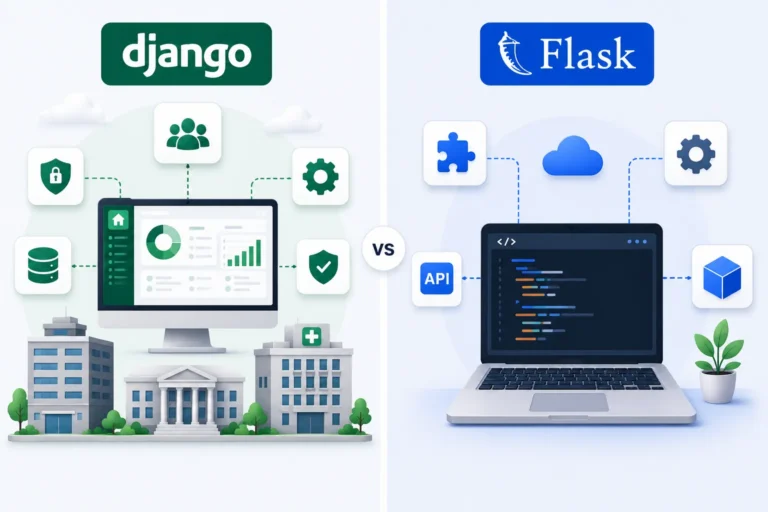
For complex business systems or large-scale applications, Django is often a preferred choice. Its built-in components allow development teams to launch fully functional applications quickly. For example, if you’re building an e-commerce platform or internal enterprise tool, Django’s comprehensive features can significantly reduce Python coding time.
On the other hand, Flask shines in smaller microservices where simplicity and flexibility are important. Flask is ideal for Python API development, quick MVPs (Minimum Viable Products), and third-party integrations.
Database Handling: Django’s ORM vs. Flask’s Flexibility
How each framework handles the database is one of the more consequential differences for a development team, and it’s not fully captured under “project size.” Django ships with its own ORM, which means models, migrations, and queries all follow one consistent pattern across the entire application. A developer joining a Django project already knows how data access is structured, because Django largely dictates that structure.
Flask has no built-in ORM. Most Flask projects use SQLAlchemy, added as an extension, though teams are free to use a different ORM entirely or skip an ORM altogether and write raw SQL. This is a genuine strength for teams with specific database requirements — direct control over queries can matter for performance-sensitive applications — but it also means database architecture decisions in a Flask project are entirely the team’s responsibility, with no framework default to fall back on if those decisions aren’t made deliberately early in the project.
2. Development Speed and Flexibility

Python is popular for its speed, and both Django and Flask enable rapid prototyping. However, they are handled differently during development. Django’s developers follow certain conventions, which can speed up Python application development for common use cases.
In contrast, Flask’s opinionated nature allows developers to structure the application however they choose. This flexibility can be great for experienced teams who want control.
3. Scalability and Performance
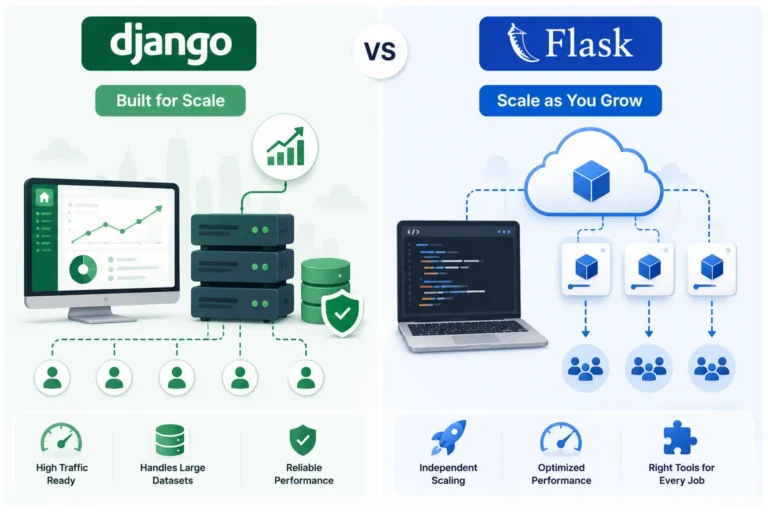
Scalability is vital for businesses expecting growth. Django can handle high traffic and large datasets, making it a solid choice for scalable Python-based web application solutions. It is used by popular platforms like Instagram and Pinterest which shows its ability to support millions of users.
Flask, can perform better for small applications and is easier to scale horizontally in microservices architectures. It’s also commonly used for building RESTful APIs. Monolithic apps benefit more from Django, while distributed systems and APIs lean toward Flask.
Deployment and Hosting Considerations
Deployment complexity differs between the two frameworks in ways that matter once a project moves from development to production. Django applications typically involve more moving parts at deployment time — a WSGI server, static file handling, database migrations that need to run as part of the release process, and often a task queue for background jobs. This isn’t a drawback so much as a reflection of Django applications tending to do more, but it does mean a Django deployment pipeline usually takes more upfront setup to get right.
Flask applications are often simpler to deploy precisely because they do less by default. A small Flask API can be containerized and deployed with a minimal configuration, which is part of why Flask is a common choice for microservices that need to ship quickly. As a Flask application grows and accumulates extensions for database access, background tasks, and caching, its deployment complexity tends to converge with Django’s — the simplicity advantage is largest for genuinely small services.
4. Community and Ecosystem

Django has an extensive ecosystem with reusable components, plugins, and third-party apps that fasters the development.
Flask also has a vibrant and growing community. The Flask ecosystem includes many extensions that can be added as needed. In either case, your team will have access to plenty of resources, tutorials, and documentation to support efficient Python application coding.
Learning Curve and Onboarding New Developers
For a business considering either framework, the degree to which a new developer can become productive in the technology is important. Django’s structure allows for a Django-experienced developer to work on multiple projects in the framework with less time spent learning the codebase due to the strict requirements of the framework. This is beneficial to a business considering Django that plans to hire or utilize multiple developers on their code.
By contrast, Flask’s lack of required structure can make it harder for a new developer to become productive. Two projects built with Flask can use completely different structure and organization, while Django projects will always have the same core structure. This is not an issue for teams of experienced developers, but can be a concern for a new developer trying to learn a new Flask project compared to a new Django project of similar complexity.
5. Security and Maintenance
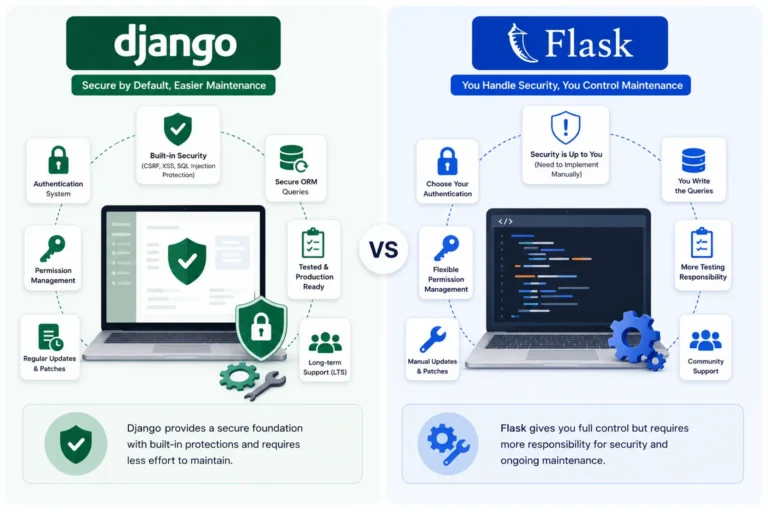
Django provides built-in security features like protection against cross-site scripting (XSS), SQL injection, and cross-site request forgery (CSRF). It encourages best practices out of the box for Python software solution development.
Flask, leaves security implementation more to the developer. When properly configured, it can be more secure. It requires more manual work to achieve Django’s level of protection. For businesses dealing with sensitive user data, Django’s built-in security features can reduce legal risks.
Real-World Migration Scenarios: When Teams Switch Frameworks
Framework decisions aren’t always carved in stone. Sometimes people start using Flask, for use in implementing some minor internal utility or as a proof of concept of some API, but then find themselves reusing more and more of Django’s built-in components (user auth, admin, permissions, etc.) in their own code. In this case it’s much easier to transition to Django proper rather than to fight to re-invent these wheels. It’s not really an anti-pattern unless you started using Django as a learning tool and had no intention of ever adding any of the aforementioned “enterprise features” (in which case it’s a problem of not planning up-front). It’s only problematic if you weren’t aware of the need for it up-front and chose an unnecessarily restrictive toolset.
On the flip side, sometimes things work in the other way around, where a project initially designed to be a standalone app begins to feature ancillary tools written up as separate services alongside it. These may, for example have wildly differing performance characteristics (a webhook listener implemented as a small flask app running alongside a single, monolithic django instance). It’s not unheard of for people to write web applications with Django only to realize during development that a particular service would benefit from being offloaded to a separate, more performant service. This can also happen the other way around, with some people choosing to implement a Django application as a Flask app for some reason.
Which Should You Choose?
Choosing between Django and Flask depends on the scope of project, your team’s experience, and your business goals for Python web application development.
Choose Django if you need a full-featured, scalable platform for a large or complex application.
Choose Flask if you’re developing a lightweight app, microservice, or want complete control over architecture.Regardless of your choice, both frameworks are excellent foundations for robust Python-based software application solutions. Django and Flask will both serve you well, provided you align the framework to your project needs.
Cost and Team Considerations for Businesses
For a business that will fund the project, not the code, the framework’s choice is significant in the cost department, and it is useful to outline the costs. Django’s built-in features allow the business to avoid the cost of selecting and maintaining third-party extensions. It will decrease the amount of code that the development team has to write and maintain itself to implement the features Django does not include with its framework. This benefit is especially useful for projects requiring features similar to the available ones in Django, but not available in Flask.
Flask’s advantage of a lower initial cost can be significant for applications with a small scope, a single API, or an MVP release. However, for applications planning to grow in complexity and use more features, the initial cost advantage disappears because they will have to be implemented separately for Flask via extensions, while Django has them included in the core. A business should consider the projected lifespan and scale of an application when choosing between the two frameworks.