


- 1 Boosts Operational Efficiency: .NET enables seamless integration with internal systems (ERP, CRM), reducing manual tasks and improving workflow automation.
- 2 Enhances User Experience: Delivers fast, responsive, and user-friendly applications with cross-platform support and easy API integrations.
- 3 Solves Scalability Issues: .NET’s modular architecture allows applications to scale effortlessly, handling growth and high traffic without compromising performance.
- 4 Modernizes Legacy Systems: VB.NET helps transition old applications to modern frameworks while preserving essential business logic and reducing maintenance costs.
- 5 Strengthens Security & Compliance: Offers built-in security features like authentication, authorization, and secure APIs—essential for industries with strict compliance requirements.
- 6 Enables Agile Innovation: Supports rapid development cycles, allowing businesses to prototype, test, and deploy features quickly for faster time-to-market.
- 7 Provides Tailored Solutions: Custom .NET applications are built to align with unique business needs, solving specific problems and driving digital transformation.
Every business would want its application to work efficiently with a better user experience. So, they face increasing pressure to operate efficiently, adapt quickly, and deliver personalized experiences to users. There are many applications that often fall short of meeting the specific needs of growing enterprises. So, here custom web applications built with .NET development tools and technologies play a vital role.
The .NET application development framework offers powerful, scalable, and secure solutions tailored to real-world business problems. Here, we will look in more detail at web applications made with .NET, helping to solve real business problems.
Why Choose .NET for Custom Web Applications?
The .NET framework provides a flexible, cross-platform solution for building custom web applications. Designed to support security, high performance, and scalability, .NET is ideal for businesses looking to build new applications.
NET vs. Other Frameworks: Why Businesses Choose .NET for Web Applications
When selecting the programming language and framework for the custom web application development, the business may be based on the comparison of the features of possible solutions like .NET, Node.js, Java Spring, or Python Django. The alternatives have their own advantages and disadvantages that must be compared.
Firstly compared to other languages Node.js is convenient to use due to its basis in one universal language JavaScript and lightness, which makes apps development faster. However, when it comes to enterprise-level apps, some other solutions may be a better choice. The reason for this is that C# in .NET removes many errors typical for JavaScript, and it is particularly relevant for large-scale enterprise software that is intended to operate for a long time and address the needs of thousands of customers. In such cases, the ability to strictly type code is critical in order to locate and eliminate errors without spending much time and money.
Moreover, Java Spring is another great choice for developing enterprise applications since it is similar to .NET in many ways. Therefore, the decision to use Java or C# may depend on the current infrastructure and the developers’ experience since Microsoft’s technologies are often used in closed systems. In other words, if an organization uses Azure or other Microsoft products, .NET will be the best choice because of its compatibility and reduced maintenance costs. This way, this technology can be integrated into the existing infrastructure with minimal effort.
Compared to Python Django, .NET is more efficient when it comes to CPU-heavy code for enterprise apps. Although Python is great for rapid development of content-heavy websites and applications and has excellent libraries for data science, it is not as efficient in terms of performance. That is why .NET is a more reliable choice for large-scale enterprise solutions.
In conclusion, when choosing a programming language and framework for developing enterprise applications, businesses should pay attention to their infrastructure, existing technologies, and the specific needs of the application. In this way, .NET is one of the best solutions for enterprise apps development because of its versatility, reliability, and great compatibility with other Microsoft products like Azure.
.NET Core Web Application Development for Business Solutions
Here’s how applications built with .NET help solve real business problems:
1. Optimizing Operational Efficiency
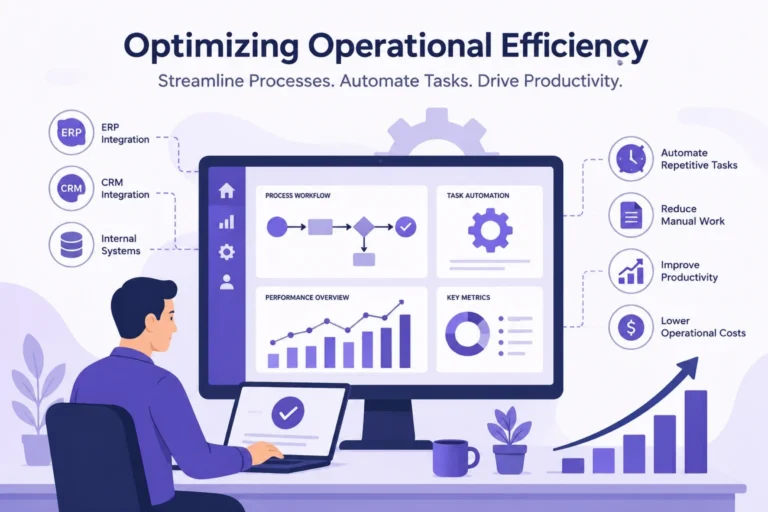
Many businesses rely on different disconnected systems that duplicate data, waste time, and slow down workflows. This is a big problem for businesses, as it affects their operational efficiency. Custom application development with .NET enables seamless integration with ERPs, CRMs, and other internal tools.
By building an application tailored to your specific processes using MVC architecture, for example, businesses can improve data visibility, automate repetitive tasks, and reduce manual work. These improvements lead directly to cost savings and improved productivity.
2. Enhancing Customer Experience

Slow applications and difficult-to-navigate applications downgrade customers’ user experience, affecting business. Customers expect fast, responsive, and personalized service. Outsourcing to enterprise that are .NET applications service providers solves this problem, as it allows for high-performance applications that can be deployed across multiple platforms.
With built-in support for APIs, your .NET application can easily integrate with external services like shipping providers, payment gateways, and marketing tools.
3. Solving Scalability Challenges

If the application does not have the scope to scale with the growth of the business, then it is a problem. Applications that are not built to scale can suffer outages, performance bottlenecks, and security vulnerabilities. The .NET’s modular architecture can scale efficiently, both vertically and horizontally.
With .NET, your business can:
- Handle high traffic without downtime
- Scale infrastructure on demand
- Ensure consistent performance
4. Legacy System Modernization with VB.NET Application Development
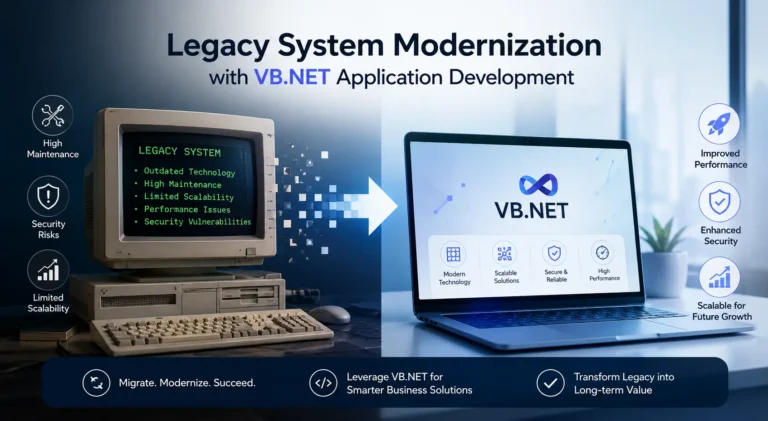
Many enterprises still operate legacy systems written in older languages such as VB6. VB.NET. These development offers a way to modernize these applications while preserving critical business logic. This transition allows companies to keep what works while benefiting from modern frameworks. Migrating to VB.NET web application development not only reduces long-term maintenance costs but also ensures compatibility.
5. Meeting Security and Compliance Requirements

Security is one of the main problems for businesses, especially in sectors like finance, healthcare, and legal services. The .NET framework can give robust security features, including built-in authentication and authorization, secure API access. Custom .NET web applications can also be designed to meet specific compliance standards, protecting your business from legal risks and potential data breaches.
6. Enabling Agile Business Innovation

The competitive and fast-moving markets must have better time-to-market. Using an agile approach supported by .NET application development, businesses can prototype, test, and deploy custom features quickly. Different technologies enable developers to separate concerns and iterate faster.
Key .NET Technologies and Tools for Custom Web Development
The “.NET framework” in reality is an ecosystem consisting of several products, more specifically, several of its components will be involved in the development of any custom web application project.
As for the first, ASP .NET Core is a .NET open source framework which allows one to create stand-alone, cloud-deployed or enterprise applications and services. Web applications built with this framework can run not only on Windows but also on macOS and Linux which makes it a great choice for cross-platform API and multi-tier web app development. Entity Framework Core is an object-relational mapper which allows one to manage databases by means of C# without writing any SQL code which in turn saves a lot of time and reduces errors during development.
Besides, Blazor is a .NET framework which allows one to use C# in web applications instead of JavaScript which makes creating interactive user interfaces easier. To implement real-time information transfer and change notification in web applications, the .NET framework provides the SignalR library, which unlike traditional approaches does not require one to develop a separate real-time layer. Microsoft Azure DevOps and GitHub Actions represent two separate products for implementing CI/CD for web applications which allows one to automatically build, test and deploy code to a specific target. This reduces the time spent on development and the number of errors due to incorrect installation or configuration of the code. Thus, advantages of the .NET framework are clear since the need for interaction between different products from different companies is eliminated and so reduces the total time and effort spent on development.
Best Practices for Successful .NET Web Application Development
While choosing the framework and tools is important for custom application development, one should also consider how a given project will be structured and maintained.
By following clean architecture principles and separating business logic from data access and presentation, one can make one’s .NET application easier to test, maintain, and scale when requirements change. This is especially important for enterprise-level applications that are going to be used for a long time after launch, as refactoring legacy code is expensive.
Automated testing, which should begin with the creation of the first working build of one’s application, allows one to spot broken logic long before one’s end-users can. By using xUnit or NUnit for unit testing and having a CI/CD pipeline as one’s primary way of delivering software updates, one can reduce the cost and time of maintaining one’s application while reducing the chance of deployment errors.
One should also note that security is a paramount concern when developing enterprise software, which is why one should use .NET’s built-in solutions for identity and authentication whenever one can. One should also ensure one’s application uses HTTPS by default and adheres to the principle of least privilege when it comes to database and API interaction to reduce one’s application’s attack surface.
Finally, one would say that one should comment and document one’s code base and, preferably, one’s entire project’s documentation, in order to reduce the amount of effort required to onboard new developers on the project.
How Much Does Custom .NET Web Application Development Cost?
Cost is often the first practical consideration for businesses evaluating custom .NET development, and its estimation depends on a number of tangible criteria worth discussing.
The primary factor in this respect is represented by the application’s complexity, which directly impacts the final price. Thus, a simple CRM with basic functionalities and a user-friendly interface will generally be significantly cheaper than a complicated enterprise-level solution. The former usually involves developing a set of conventional business tools (e.g. order processing) and a relatively uncomplicated UI, whereas the latter requires a team of developers, designers and project managers to build a product featuring advanced modules and multiple integrations. In this respect, the number of third-party services to be used is also a key cost driver because the more APIs and external systems (ERPs, CRMs, payment systems, etc.) to be integrated, the more time is needed to design and test the connections.
Another criterion related to cost is the engagement model used in the development firm’s hiring. In most cases, a company with an established .NET track record and domain expertise will be able to complete the task faster and to a higher standard than general-purpose development teams. This may be especially true for firms without in-house .NET expertise, for whom custom development often precedes years of software maintenance and updates. Finally, a crucial point that many businesses fail to consider is represented by the operating expenses related to .NET applications. More specifically, it is worth comparing the cost of software maintenance and updates (security updates, infrastructure upgrades, etc.) to the initial cost of development to ensure that the new application will not become operationally too expensive in the long run. Alternatively, businesses should assess the value of transitioning from legacy systems and inadequate off-the-shelf solutions to a properly designed custom application.
Looking to Solve Real Business Problems with .NET?
Whether you’re aiming to improve internal operations, create new digital products, modernize legacy infrastructure, or solve other business problems, custom web applications built with .NET core web application development provide a powerful solution.
The .NET empowers businesses to solve complex problems and achieve business goals. By partnering with a skilled enterprise .NET applications service, you can ensure that your custom application is designed properly.
Now’s the time to solve business problems along with exploring what a custom-built solution can do for your enterprise.