



- 1 Component-Based Architecture – Enables reusable UI components, speeding up development and ensuring scalability.
- 2 Enhanced Performance with Virtual DOM – Optimizes rendering, reducing load times and improving user experience.
- 3 One-Way Data Binding – Ensures stability, reduces errors, and simplifies debugging.
- 4 Cross-Platform Compatibility – React Native allows development for both iOS and Android with a single codebase.
- 5 Strong Community Support – A vast ecosystem with frequent updates, libraries, and skilled developers for seamless development.
Are you constantly looking for efficient ways to build scalable and high-performing applications? There are many technologies used today for app development. However, ReactJS has emerged as one of the most preferred frameworks by many app developers.
ReactJS uses JavaScript libraries for front-end app development. They can empower you to build a high-quality app as per the requirement. Many established companies using react.js technology significantly for enhancing app’s performance and user experience.
Why Use ReactJS For App Development Services?
We will explore 5 reasons why you should choose ReactJS for app development:
1. Component-Based Architecture for Faster Development
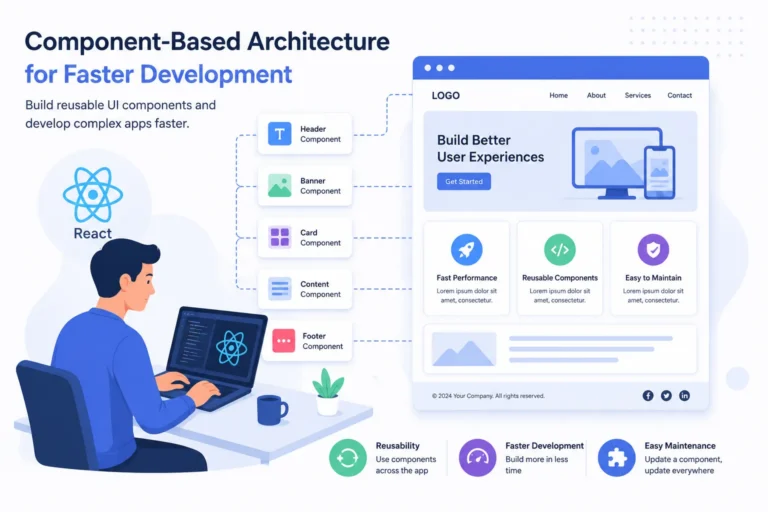
One of the biggest advantages of ReactJS is that it has component-based architecture. This means that developers can create reusable UI components, making the development process in an efficient and scalable way. By breaking the user interface into smaller, self-contained components, developers can build, maintain, and update applications with ease.
With this modular approach, react native development services can save costs and development time. Businesses can also benefit from faster iterations and seamless scalability, which will ensure that applications are future-proof.
2. Better Performance with Virtual DOM

Performance plays an important role in the success of any application. ReactJS utilizes a Virtual DOM (Document Object Model). It optimizes the rendering process and increases the speed of web applications.
Unlike traditional DOM manipulation, where every update leads to re-rendering the entire page, React’s Virtual DOM will take care that the necessary components are updated. This results in reduced load times, faster rendering, and an overall smooth user experience.
The companies providing app development services using react native will always appreciate when building high-performance applications.
3. One-Way Data Binding

In ReactJS framework, data flows in one direction. Thus, it helps to track and debug changes, making the app more stable and predictable. It also helps in reducing errors and maintaining the app well.
4. Cross-Platform Compatibility with React Native

Another significant advantage of ReactJS is its seamless compatibility with React Native development services, allowing developers to build cross-platform mobile applications using the same codebase. This means businesses can develop applications for both Android and iOS without having to build separate codebases for each platform.
With React Native app development services, companies can create mobile applications with native-like performance while reducing development costs. This makes React an ideal choice for businesses looking to expand their reach across multiple platforms efficiently.
5. Strong Community Support and Ecosystem

ReactJS is backed by a vast and active developer community. This means frequent updates, continuous improvements, and a wealth of resources, including libraries, tutorials, and third-party integrations can be done. Whether you need ReactJS app development services or custom solutions, you can find skilled developers and a robust ecosystem to support your project.
Using ReactJS for Building Scalable Business Applications
As an application evolves, implementing additional functionality without breaking the current experience may become difficult. With ReactJS, the process of developing scalable applications becomes easier due to possibility of implementing an application through use of reusable components.
When developers do not have to handle the whole interface as one huge code, they will be able to break it down into parts, which may be modified independently. This way, it is possible to implement new functionality, solve problems and maintain the application according to changing requirements.
ReactJS is also compatible with a variety of development libraries and tools. As such, businesses will be able to select the necessary tools for implementation of routing, state management, form management, testing, and other aspects of an application without having to change its architecture completely.
Moreover, the same development strategy may be applied to creation of mobile applications due to the existence of React Native framework. In this way, companies will get the chance to benefit from sharing the knowledge and, if possible, code and components between web and mobile applications.
Overall, ReactJS may become a useful option for creation of applications by evolving businesses.
Will You Try Using React.js for App Development ?
ReactJS has revolutionized the way applications are built, offering unmatched performance, scalability, and ease of development. If you’re looking for app development services, using React Native framework will surely be beneficial.By leveraging ReactJS development, businesses can create high-performing, SEO-friendly, and scalable applications with ease. If you’re planning your next digital project, partnering with ReactJS development companies can help you achieve your goals efficiently. So, let’s get started with ReactJS app development services right away!
Getting Started: The Usual Shape of a ReactJS Project
The majority of ReactJS projects have more or less the same pattern, right after the business decides to make a product. There is always a discovery phase when the dev team studies the purpose of the app, its target audience, and what features should be prioritized. Skipping this step is a common reason why many digital products suffer from poor launch positioning: repurposing a working prototype is significantly cheaper than rewriting a completed project.
After the requirements are set, developers usually design and develop the component library, following the component-driven approach. It helps prioritize smaller independent elements of the larger whole, such as buttons and forms and build them into complex interfaces later by assembling those components into pages. While it might seem like a longer way to plan around each element rather than coding blindly and adjusting the code later, it usually saves time and energy for bigger projects due to reduced rework.
Another important decision concerns the state management structure, which highlights the differences between small-scaled applications and those that presuppose complex data sharing between elements. The latter normally require such tools as Redux or Zustand, while apps with fewer interactive elements can rely on React state. State management solutions help assemble an application’s logic, so it is always wiser to think about their implementation ahead of time rather than retrofitting old code later.
Finally, the development process is not the time when testing is postponed until the end of the project. With component-based applications, it is easier to adjust individual building blocks of the larger system than to debug the entire application after all codes are merged. In general, most applications have already undergone a significant portion of requisite updates and quality assurance measures prior to launch, which make them less intimidating than one might expect. This way, applications using ReactJS rarely have a major redesign ready at launch: most projects normally carry their evolutionary potential with them at all times on multiple levels.
A Quick Note on Maintenance After Launch
Launching the app is only a small victory for most development teams. Even if everything went perfectly, the changes in the first few weeks usually involve tweaks to the parts of the application that were previously working reasonably well. It is normal for developers to make some mistakes while testing and preparing the product for official launch. However, a considerable part of such defects emerges as the software starts working in the hands of its users.
Due to ReactJS’s component-based nature, the refactoring process for applications built with this technology should theoretically involve fewer risks. As such projects are developed using individual components, any adjustments to the code can, in most cases, be isolated to a particular element. It makes maintenance simpler and reduces the risk of errors in other parts of the application. For this reason, applications built with React should, in theory, be easier to maintain and update long after the initial launch.